
Wise Data Science
AutoResearch: How AI Helps Data Scientists at Wise Test More Hypotheses—Faster
Authors: Hung Chit Tse, Data Scientist, Hasan Burak Yel, Data Science Lead
As a modern fintech company, Wise relies on machine learning (ML) models for critical operations and growth, from foreign exchange (FX) forecasting and AML, to financial forecasting and marketing customer lifetime value (LTV).
Historically, experiment execution is the main bottleneck of ML development - data scientists have more hypotheses than capacity to test them.
AutoResearch is an AI-powered ML development framework that automates repetitive implementation and experiment execution, enabling data scientists to test more ideas at speed.
We recently used AutoResearch to autonomously develop a better-performing financial forecasting model. We think the bigger opportunity is letting data scientists scale their thinking while AI scales the execution.
This post explains how we did it, how to scale the approach, and how AutoResearch can empower data scientists at Wise to turn more ideas into impact.
What Is AutoResearch and How Does It Work?
AutoResearch is an AI-powered model development framework introduced by Andrej Karpathy in March 2026. It uses LLM agents to autonomously implement and evaluate model changes, iteratively improving performance.
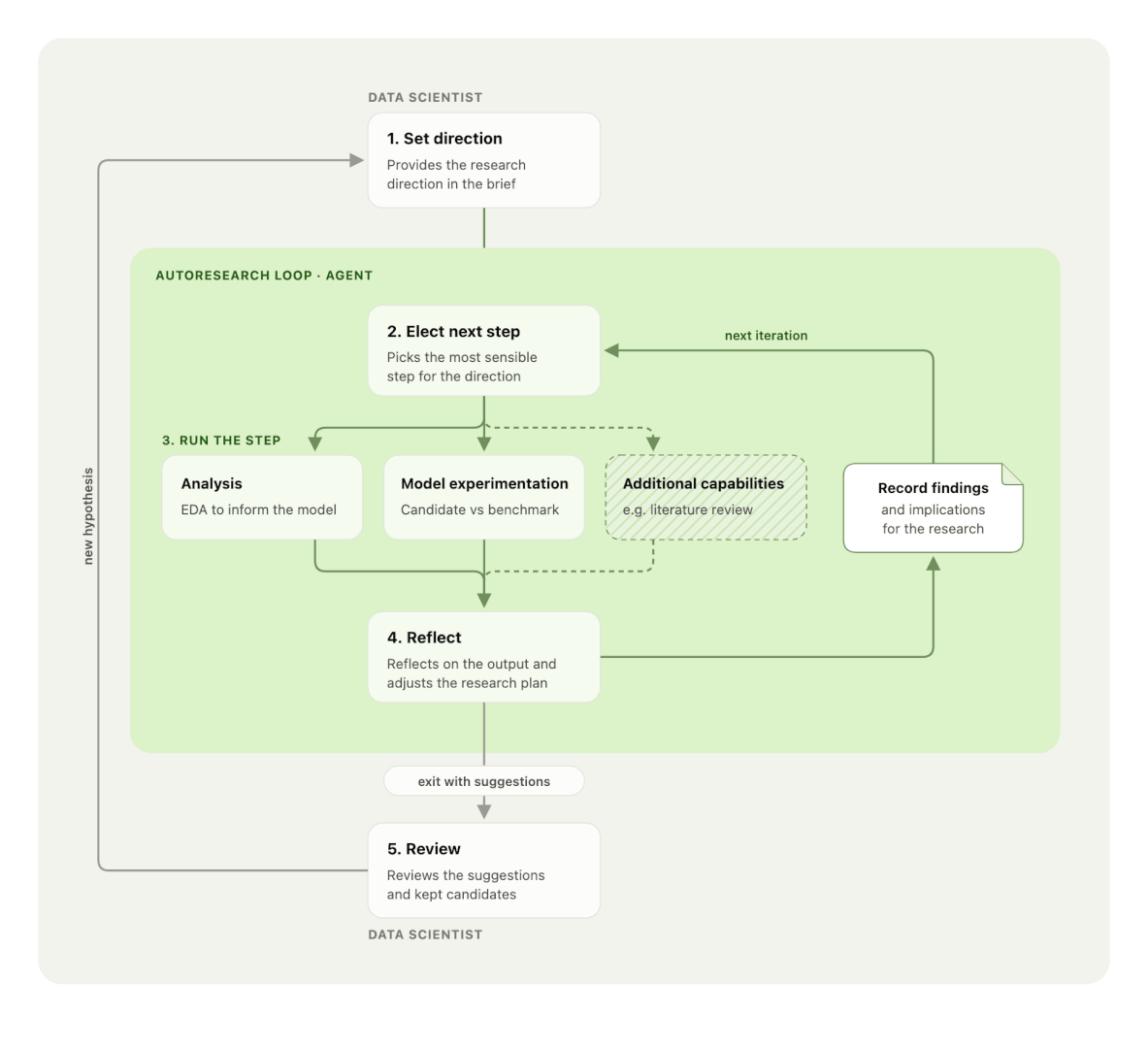
At Wise, we extended this approach into a governed, autonomous ML research workflow. In each cycle, the agent:
- Chooses the next experiment based on the research objective and previous results.
- Implements a candidate model or model change.
- Evaluates the candidate against a fixed evaluation setup, then keeps or discards the change based on the results.
- Reflects on the outcome to refine the research direction and propose the most promising hypotheses to test next
Between experiments, the agent also refines the direction of research by:
- Exploring modelling data.
- Diagnosing candidate performance.
- Reviewing relevant literature.
- (we are continuously expanding the actions space)
Putting AutoResearch to the Test: Financial Forecasting
AutoResearch adoption at Wise is still early, but it’s already showing promise in production use cases—including Wise’s financial forecasting system.
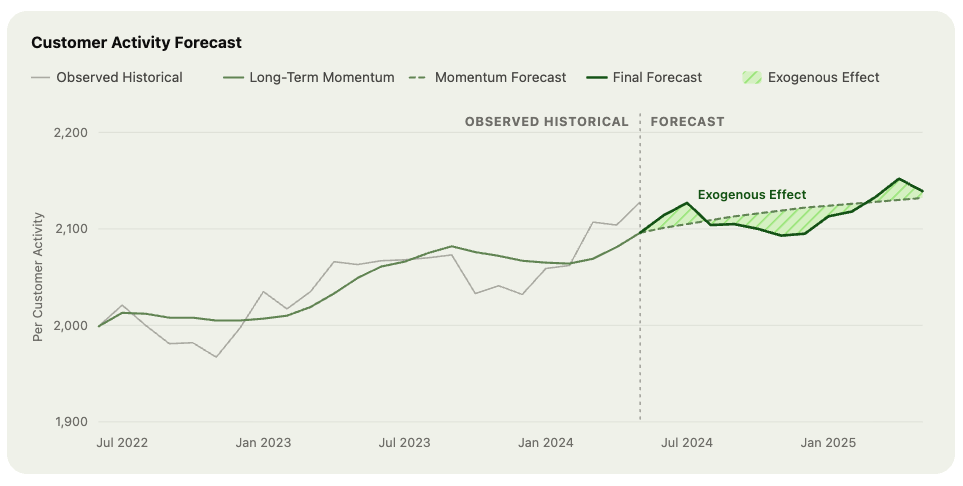
One early test focused on the Customer Activity Model, which predicts average customer activity across hundreds of customer segments. Together with a model of how the customer base evolves, it forms a core part of financial forecasting.
The challenge was to capture both long-term momentum and short-term exogenous effects, such as seasonality, while keeping predictions explainable.
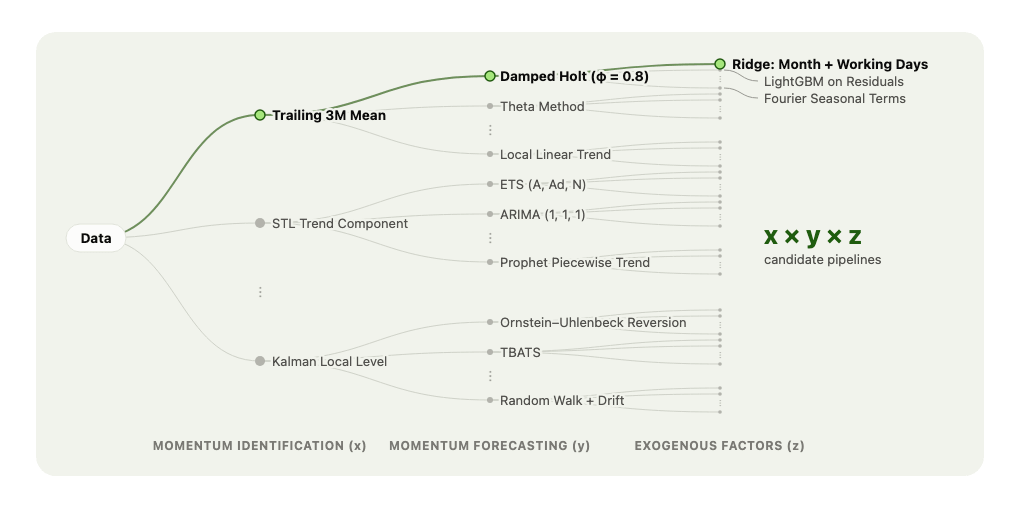
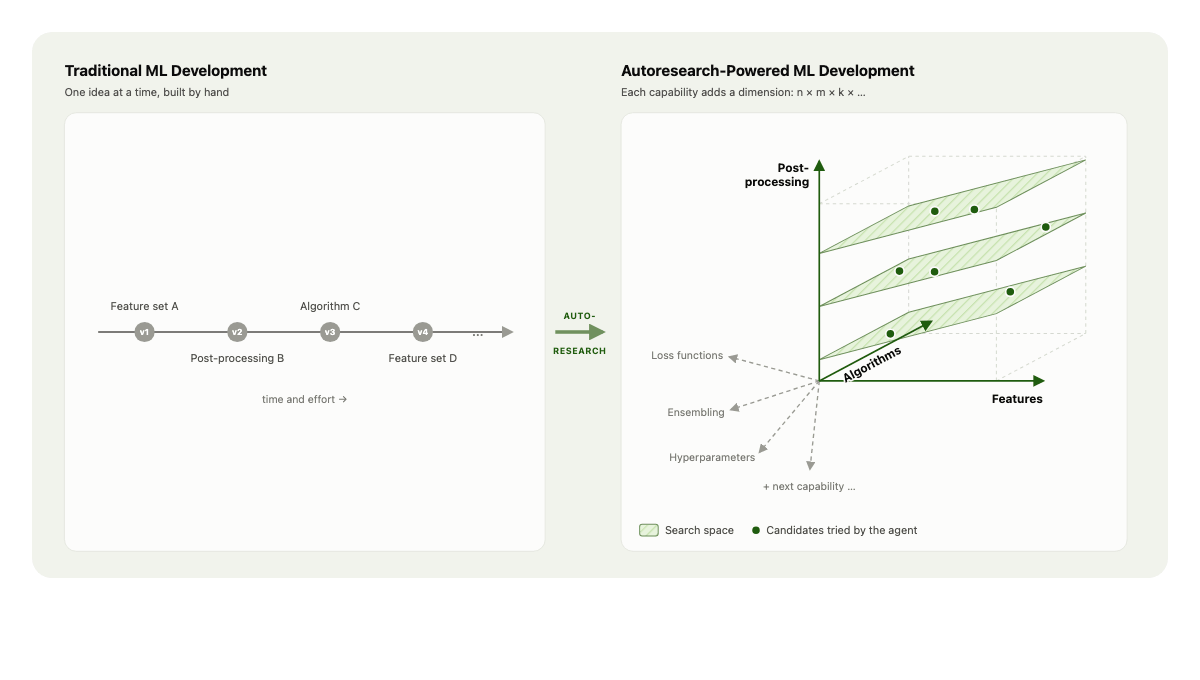
The starting hypothesis was to model persistent momentum separately from short-term shocks. Testing it meant exploring X methods to identify momentum, Y to forecast its trajectory, and Z to account for external factors—an X × Y × Z search space.
Given a clear objective and this hypothesis, AutoResearch autonomously ran around 25 experiments, producing a model improving performance by ~5% and improved explainability.
The full journey from ideation to production deployment took two days—a process that historically took weeks. The data scientist supplied the research direction; AutoResearch handled the iterative implementation and testing.
From One Experiment to a Repeatable Research Workflow
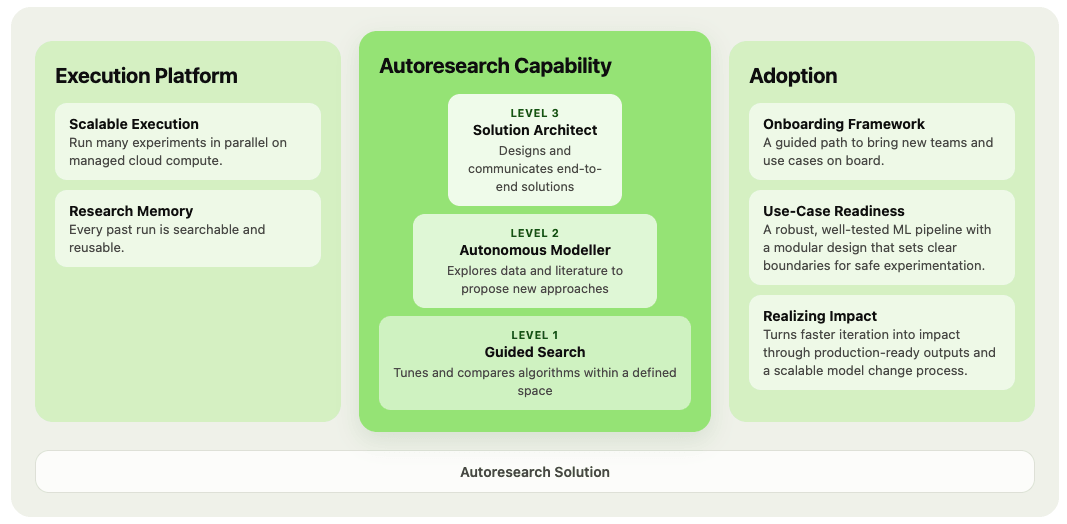
This early signal of success motivates us to scale AutoResearch across Wise. Moving from an isolated win to a repeatable, production-grade workflow comes down to three core pillars:
Pillar 1: Core Autoresearch Capability
This pillar focuses on what the framework can robustly execute, through a dependable harness for the agent. In practical terms, this means expanding the toolkit the agent has access to while ensuring a disciplined, robust decision-making trajectory. Over time, we expect the agent to evolve from “Grid Search on Steroids” into an “Autonomous Solution Architect.”
Pillar 2: Adoption
Adoption depends on three key factors: onboarding seamlessness, codebase readiness, and impact realisation.
- Reducing onboarding friction: Successful AutoResearch requires embedding the framework while preserving domain-specific ML context. We achieve this using standardised agentic skills that deeply learn each use case before setup.
- Codebase readiness: AutoResearch thrives on clean, modular abstractions. In monolithic architectures, separating the scope of experimentation from fixed guardrails is significantly harder. We encourage modular pipeline design through shared conventions and AI-assisted development tools.
- Impact realisation: Value comes from deployed models, not winning experiments. We turn faster iteration into impact through production-ready outputs and a scalable model change process.
Pillar 3: Execution Platform
The true value of AutoResearch lies in freeing up data scientists to focus on the “outer loop” of high-value activities (e.g., solution architecting, hypothesising with deep intuition). This requires an execution platform designed to support that shift: a scalable environment capable of handling the elevated compute load as more ideas are tested, reliable tracing and observability to ensure the AutoResearch agent’s “inner loop” is well-reasoned, and a library system that enables data scientists (and AI) to preserve and build upon learnings from preceding trials.
Let Agents Run Experiments. Let Data Scientists Drive the Research.
We think AutoResearch lets data scientists scale their thinking rather than their manual effort.
Traditional ML development scales one idea at a time: a new feature set, post-processing step, or algorithm adds another model variant to test.
With AutoResearch, data scientists shift from implementing individual variants to designing reusable capabilities that unlock entire axes of exploration. For example, a flexible feature-ingestion framework lets the agent explore many feature combinations instead of testing one predefined set.
Each new capability expands the search space, allowing data scientists to focus on research direction and architecture while agents explore the possibilities.
More Data Science projects
Related blogs
Teaser
People profileContent Type
BlogPublish date
03/02/2026
Summary
"When you join, you’ll see your own growth mirrored by the growth of the company. You won't just be watching change happen; you’ll be a direct part of it." Ataro Shoji (He/Him) Payment

by
Verona Hasani
Teaser
People profileContent Type
BlogPublish date
06/27/2025
Summary
We sat down with SK Saraogi, Head of Expansion APAC, to discuss our strategic expansion into Hyderabad, India 🇮🇳Read more to discover why Hyderabad is the perfect location for our second glo
by
Verona Hasani
Teaser
People profileContent Type
BlogPublish date
06/06/2025
Summary
Driven by a passion for growth and team development, discover how Anna Pavlics advanced from Agent to Team Lead in Wise's Fraud Prevention team 🚀 "We put tremendous effort into bui
by
Verona Hasani
Teaser
People profileContent Type
BlogPublish date
02/18/2025
Summary
Head of Servicing Scale and Experience, Ian Rynne, discusses his journey from starting as a Customer Support agent to becoming the Head of Servicing Scale and Experience at Wise.
by
Verona Hasani
Teaser
Our cultureContent Type
BlogPublish date
05/15/2024
Summary
My name is Cynthia. I'm a fraud agent at Wise, based in the Austin office. We strive to prevent fraudulent activity on the Wise platform. It can be tricky, as Wise supports many diff
Content Type
BlogPublish date
01/24/2024
Summary
Wise’s volunteer day is not just a perk; it’s a celebration of community, camaraderie, and making a difference.Meet Claire Adelman, Customer Support Training Specialist, and Javier Perdo
Teaser
People profileContent Type
BlogPublish date
11/24/2022
Summary
Hi! My name is Delis and I’m a Due Diligence Agent (CDD) in our Tallinn team, focusing on business verification. What this means is that I onboard high risk businesses by assessing their r
Teaser
People profileContent Type
BlogPublish date
11/24/2022
Summary
Hi! My name is Rza Mustafayev and I’m a Due Diligence Agent in our Latin America & Middle-East and Africa Region, focusing on personal and business customers. What this means is that I:Rev